Eight characters used to be the advice. Uppercase, lowercase, a number, maybe a symbol. Security teams drilled it into employees for two decades. By 2026, that advice is costing people their accounts.
A 2025 study testing 14.2 million real-world passwords found that 85.6% of them could be cracked by an AI-powered system in under ten seconds. AI-grade GPU clusters now accelerate cracking speeds by roughly 1.8 billion percent compared to a single consumer GPU, collapsing timelines that used to be measured in centuries down to hours for passwords that were once considered strong.
The attackers are not guessing anymore. They are learning. AI systems trained on hundreds of millions of leaked credentials have mapped out how humans actually construct passwords: where we capitalize, where we add numbers, which symbols we reach for, how we substitute letters. "P@ssw0rd" is not clever. "Summer2025!" is not creative. They are predictable patterns that AI already knows to try first.
Why 8-Character Passwords Are Finished
The math is not complicated, but the implications are significant.
Here is where the numbers land, based on Hive Systems benchmark data and current GPU rig capabilities:
| Password length | Complexity | AI crack time (2026) |
|---|---|---|
| 8 characters | Complex (uppercase, symbols, numbers) | Hours to months |
| 12 characters | Complex (uppercase, symbols, numbers) | ~3 weeks on RTX 5090 cluster |
| 15 characters | Lowercase passphrase only | Hundreds of millions of years |
| 16+ characters | Random mixed | Effectively uncrackable |
⚠️ The LLM Entropy Trap: Why AI chatbots cannot generate secure passwords
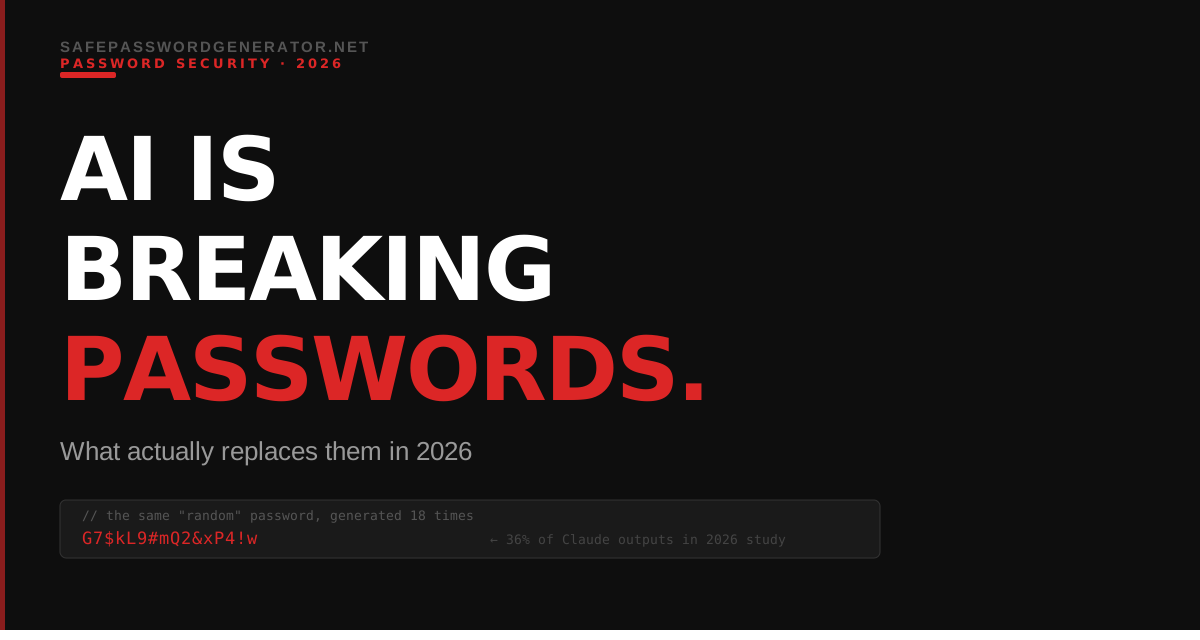
In 2026, researchers at Irregular (Frontier AI Security) tested Claude Opus 4.6, GPT-5.2, and Gemini 3 Flash by prompting each to generate a password 50 times in fresh sessions. Claude produced only 30 unique passwords across those 50 attempts. One string, G7$kL9#mQ2&xP4!w, appeared 18 times, giving it a 36% probability of being generated. A truly random 16-character password would have near-zero probability of repeating.
The finding was picked up by Schneier on Security and independently verified across all three models. GPT-5.2 passwords almost always started with "v," while Gemini favored "K" or "k." These are exploitable patterns that an attacker who knows AI generation biases can target directly.
Password strength checkers rated Claude's output at approximately 100 bits of entropy. The real-world entropy was approximately 27 bits. That is the difference between "trillions of years to crack" and seconds on a standard machine.
The fix: use a browser-local generator backed by a CSPRNG, not an AI chatbot. The generator at the top of this page uses the Web Crypto API and produces genuinely uniform randomness. Read the full Irregular research breakdown here.
The counterintuitive finding is that length beats complexity by a wide margin. A 15-character lowercase passphrase has a search space of 2615, roughly 1.7 quadrillion combinations. A complex 8-character password using 95 possible characters has a theoretical search space of 958, about 6.6 quadrillion combinations on paper. But AI-assisted cracking does not work through every combination in sequence. It prioritizes the patterns humans actually use, and short "complex" passwords are heavily pattern-mapped from breach data. The long passphrase wins because length compounds faster than character-set size, and human pattern bias is less exploitable at greater lengths.
NIST formalized this in its 2025 updated guidance, shifting its recommendation toward passphrases and away from complex character substitutions that users game predictably. The guidance now emphasizes 15 or more characters over the older complexity rules.
Most people are not using 15-character passwords. A 2025 study found that roughly 94% of passwords in breach data are weak or reused, and "123456" still appears millions of times in recent leak datasets. Every one of those accounts is effectively open.
What AI-Powered Cracking Actually Looks Like
When attackers get access to a database of hashed passwords, they are not sitting at a keyboard guessing one by one. They run automated tools against the hash file offline, on hardware they control, at speeds that can test billions of combinations per second.
AI accelerates this in two ways. First, GPU clusters handle the raw compute: a rig of 12 NVIDIA RTX 5090 GPUs can brute-force an 8-character lowercase password in roughly three weeks. Second, machine learning models trained on breach data make educated guesses first, targeting the patterns humans use most. This combination means that statistically common passwords, including most passwords real people are currently using, fall far faster than the theoretical brute-force timeline suggests.
One 2025 mega-leak exposed approximately 16 billion credentials from major platforms. That data does not just enable direct account access through credential stuffing. It becomes training material for the next generation of cracking tools. Every breach makes the next attack faster.
The Passwordless Push in 2026
The security industry's answer to this problem is passwordless authentication, specifically passkeys, and the adoption curve has shifted meaningfully over the past 12 months.
Passkeys replace the shared secret model entirely. Instead of a password stored somewhere a breach can expose, a passkey uses a cryptographic key pair: the private key stays on your device, the public key goes to the service. Authentication happens through a challenge-response that cannot be phished because the key is bound to the specific site it was created for. A fake login page cannot capture what is never transmitted.
The numbers behind adoption are real. Google saw passkey authentications grow 352% after making them the default for personal accounts. Microsoft made passkeys the default for all new accounts in May 2025, producing a 120% increase in authentications. Gemini required passkeys outright, which drove a 269% surge. FIDO Alliance reported 15 billion passkey-enabled accounts by the end of 2024, more than double the prior year.
Despite that momentum, 76% of organizations still rely on legacy passwords as of early 2026, per the State of Passwordless Identity Assurance report. And 87% of organizations still use password-based authentication for customer-facing applications, per the Descope State of Customer Identity survey, even though only 2% of respondents believe passwords effectively balance security and usability. The gap between knowing passwords are broken and actually replacing them is wide.
For most people in 2026, passwords are not going away this year. They are living alongside passkeys on most of the sites they use. That means the transition period, which could run through 2027 or beyond for many platforms, requires a realistic intermediate strategy.
What Actually Protects You Right Now
Waiting for every site to support passkeys is not a plan. The realistic 2026 baseline has two components: password length and a manager.
On length: NIST's current guidance is 15 or more characters. A randomly generated passphrase at that length is effectively uncrackable by brute force with any hardware available today. "correcthorsebatterystaple" is famous but now too widely known to use as an example. Generate something genuinely random, and generate it locally. SafePasswordGenerator.net runs entirely in your browser: the password is generated client-side, never transmitted to a server, and never logged. Unlike asking an AI assistant, nothing leaves your device.
On a manager: The reason most people use weak or reused passwords is that strong, unique passwords for every account are impossible to remember. A password manager eliminates that tradeoff. You remember one strong master password; the manager handles everything else, generates unique credentials per site, and flags reused or compromised passwords.
NordPass: Built for the Password-to-Passkey Transition
NordPass supports passkeys alongside traditional passwords, which matters during this transition period. It runs on zero-knowledge architecture, meaning your vault is encrypted client-side before it ever reaches their servers. Breach monitoring alerts you when credentials associated with your email appear in leaked data.
See NordPass Plans →The combination is not complicated: long generated passwords for sites that do not yet support passkeys, passkeys where they are available, and a manager to handle both. That is the setup that actually holds up against what AI-powered cracking looks like in 2026.
The Passkey Transition Is Real but Uneven
A few things worth knowing as passkeys spread:
Not every platform has them yet. Major consumer platforms, including Google, Microsoft, Apple, Amazon, and PayPal, support passkeys now. Legacy enterprise systems and smaller sites are slower. You will be living in a hybrid world for the foreseeable future.
Account recovery is the weak point. Passkeys are phishing-resistant at login. They are not immune to account takeover if your recovery options are weak. A phone number tied to SMS recovery is still vulnerable to SIM-swap attacks. Review your recovery methods on high-value accounts.
Portability is improving. Apple's iOS 26 update introduced credential portability through the Credential Exchange standard, allowing passkeys to move between Apple's built-in manager and third-party tools. This was a meaningful shift from Apple's historically closed approach and makes passkeys more practical for people who use cross-platform credential managers.
The Bottom Line
The assumption that a short, complex password is protecting your accounts is wrong, and it has been wrong for longer than most people realize. AI-assisted cracking has accelerated a timeline that was already moving against static passwords. The direction the industry is heading, toward passkeys and cryptographic authentication, is correct. The reality is that most of us are not fully there yet.
What you can control today: generate longer passwords, stop reusing credentials across sites, and use a manager that handles the friction. Start with a free generated password at SafePasswordGenerator.net, entirely browser-side, nothing stored. For managing everything after that, NordPass is where to start.
FAQ
Can AI crack any password instantly?
Not any password, but most passwords real people are currently using. A 2025 study found 85.6% of common passwords fall in under ten seconds. Truly random passwords of 15 or more characters remain computationally uncrackable with current and near-future hardware, regardless of AI acceleration.
How long should my password be in 2026?
NIST's 2025 updated guidance recommends 15 or more characters. At that length, a randomly generated password has a search space that makes brute-force cracking effectively impossible with current GPU technology. Length matters more than complexity: a 15-character lowercase passphrase outperforms an 8-character string with symbols.
Are passkeys safe to use in 2026?
Yes. Passkeys use public-key cryptography and are bound to the specific site they were created for, making them phishing-resistant by design. They are the most secure login method available for consumer accounts. The caveat is that your account recovery options need to be strong as well, since a weak recovery path can undo what a passkey protects at login.
Why use SafePasswordGenerator.net instead of asking an AI chatbot for a password?
SafePasswordGenerator.net generates passwords entirely in your browser using the Web Crypto API. Nothing is transmitted to a server, and nothing is logged. When you ask an AI assistant for a password, that request and response travel over a network and may be logged by the provider. For credentials that protect real accounts, browser-local generation is the safer approach.
What is the best password manager for the passkey transition?
NordPass is the manager I recommend for most people during the current transition period because it supports both traditional passwords and passkeys in a single vault, uses zero-knowledge encryption, and includes breach monitoring. It handles both credential types without requiring separate tools.
Is 94% of passwords really weak or reused?
That figure comes from a 2025 analysis of breach data, which found roughly 94% of passwords in real-world leaked datasets were either weak by complexity standards, reused across multiple accounts, or both. It aligns with other research showing that "123456" alone appeared millions of times in recent leak data, and that credential stuffing, which exploits reused passwords, accounted for 22% of all data breaches in 2024-2025.